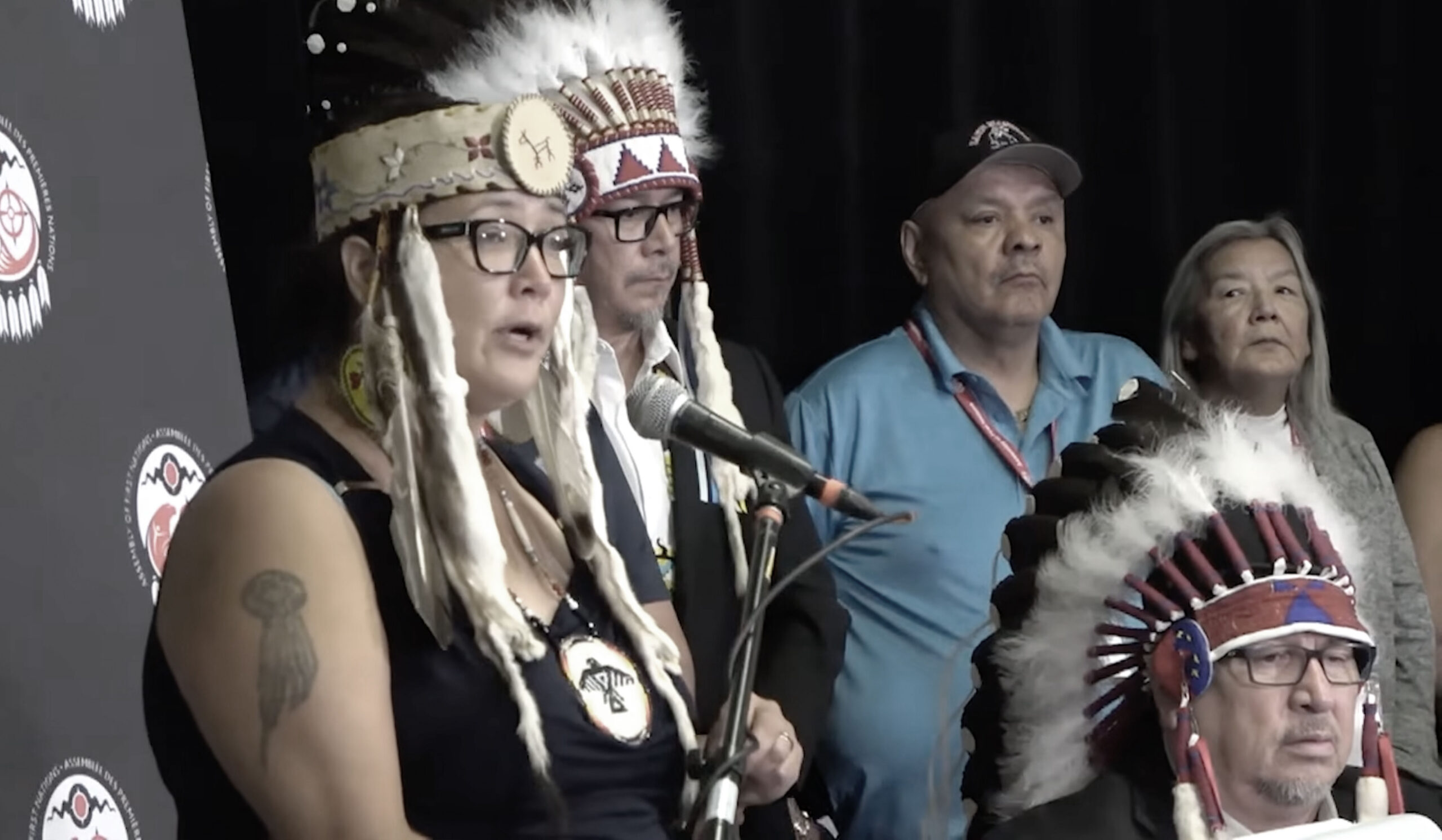
The Assembly of First Nations has passed an emergency resolution calling on the federal government to criminalize what it calls “residential school denialism.” At its annual general assembly in Ottawa, chiefs voted to push for either amendments to the Combating Hate Act or brand-new stand-alone legislation that would make it a criminal offence to publicly condone, deny, justify, or minimize the residential school system and related claims, including those involving unmarked graves.
This comes hard on the heels of a Senate vote that rejected a similar attempt. Senators voted 41 to 32 against an amendment to Bill C-9 that would have treated residential school denialism as a hate crime, punishable by up to two years in prison. First Nations leaders have responded with sharp criticism. Manitoba Grand Chief Garrison Settee called it a shame that Canada will not protect people from what he describes as hate crimes. Other chiefs have framed the Senate’s decision as a setback for reconciliation and a failure to defend historical truth.
Here is the key part: the resolution defines denialism in very broad terms.
It is not limited to claiming the schools never existed. It includes questioning the scale of harm, the interpretation of events, or the claims about mass graves and missing children that exploded into national headlines after the 2021 Kamloops announcement. Chiefs have argued that such questioning reopens wounds, dishonours children, fuels racism, and undermines reconciliation. Some have drawn direct comparisons to laws against Holocaust denial, insisting the same standard should apply here.
This is a dangerous path for a free society. Once governments start criminalizing opinions about historical events, especially events still under active investigation and debate, the line between protecting people from hate and enforcing a single approved narrative becomes very thin.
The residential school system was real. Children were taken from their families, many suffered abuse and neglect, and some died while attending the schools. Those facts are documented and not in serious dispute among serious people. What remains contested is the precise scale of certain claims, the interpretation of ground-penetrating radar anomalies, and the repeated assertion of “mass graves” when, years later, no human remains have been excavated and confirmed at several of the most publicized sites.
Five years after the Kamloops announcement that triggered a national mourning period, flags at half-mast, and a wave of church burnings, not a single confirmed burial of murdered children has been produced from those radar hits. Many of the “anomalies” have been quietly reclassified or left unexamined. Books and careful reporting have documented how media and political institutions raced ahead of the evidence, treating preliminary findings as settled proof of genocide.
Questioning that rush is not hate speech. It is the ordinary work of seeking accuracy.
Criminalizing that questioning would not heal trauma. It would shut down the very process of establishing what actually happened. Survivors deserve honesty, not enforced consensus. Canadians as a whole deserve a system that can distinguish between established historical fact and claims that remain unverified or have been overstated. Treating legitimate skepticism as a form of hate risks turning the justice system into a tool for enforcing orthodoxy rather than protecting people from real violence and discrimination.
The comparison to Holocaust denial laws is imperfect at best. The Holocaust rests on mountains of documentary evidence, forensic work, survivor testimony, and the records of the perpetrators themselves. The most explosive recent claims about residential schools rest, in several high-profile cases, on radar images and oral accounts that have not yet been subjected to the same level of physical verification. Elevating those claims to the status of unchallengeable truth, and then jailing people who question them, is not reconciliation. It is the opposite.
Parliament should reject this pressure. Free societies do not criminalize historical debate. They test claims against evidence and allow the public to weigh the results. Survivors who suffered real harm are not served by laws that make it risky to ask hard questions about numbers, methods, or media coverage. If the goal is truth, then the path is more investigation, more excavation where appropriate, more transparency about what has and has not been found, and less reliance on criminal sanctions to settle arguments.
True North was among the first organizations in Canada to challenge the more extreme versions of the residential school narrative when the media and political class were still treating every radar anomaly as confirmed proof of mass murder. We published Grave Error and Dead Wrong, two books that carefully examined the claims, the evidence, and the fallout. Both became bestsellers because many Canadians were hungry for a clearer accounting of the facts. Those books remain essential reading for anyone who wants to understand how the conversation went off the rails and what a more honest approach would look like.
You can find Grave Error and Dead Wrong on Amazon. They are the record of an early and consistent effort to insist on evidence over emotion, and they remain just as relevant today as the pressure to criminalize dissent grows stronger.